Assalamualaikum and good afternoon to all.
It is a great pleasure and honor for me to speak in front of an accomplished audience. For today I am speaking not to an ordinary group of graduates; today I am speaking to a group whom can now be called professionals. I must take this opportunity to first thank my parents, my other family members and friends, my teachers of past and present, and as a doctor, my patients. Without all of them, I would not be as successful as I am today, nor selected to speak to address such a special group of graduates. For who I am today is a product of all those I mentioned above.
For you are a special kind of audience. You are an audience of whom standards are not just set by your teachers; the standards of your proficiency of practice is also set by your senior professionals, who have set high standards upon themselves. To graduate as a doctor, an allied health professional, or a lawyer means that there is no question regarding your qualification.
I still remember 7 years ago, when all of us were a group of students who had just finished the SPM examination, and were just about to begin a new phase as students in the Matriculation Center. At that moment many of the faces I saw were a mixture of excitement and anxiousness. We thought that SPM was hard. Would we survive the next 5-7 years of education? An education that is more specialized, yet harder. Nevertheless at the time there was always those moments of youthfulness. Late nights, last-minute studies, and of course the obligatory sleeping in class. This was the same regardless of the course undertaken by the students. Even Medicine.
Now fast forward to the moments right before the graduation. At that time you can also see the same mixture of excitement and anxiousness. But now it was for a different reason: We were preparing for the professional exams. An exam where you are judged not just by your regular teachers; but judged by professionals who are going to see you for the first time, and probably the last time. And this is what I mean to speak to a special group of graduates. You are graduates who are trusted not just by your own lecturers, but also by other professionals who have never met you before; who are convinced by your knowledge and skills the only time they saw you. You have achieved success, surely to be envied by others.
Kejayaan itu adalah sesuatu yang patut diraikan. Ini adalah kerana sesuatu kejayaan akan membawa kepada kejayaan yang seterusnya. Akan tetapi kejayaan kamu pada hari ini adalah hasil campuran pelbagai elemen. Ia bukan sahaja hasil daripada titik peluh usaha tuan-tuan dan puan-puan graduan. Kejayaan kamu pada hari ini juga adalah hasil daripada pengorbanan tenaga dan wang ibu bapa dan ahli keluarga kamu, daripada pengorbanan guru-guru, dorongan dan kerjasama rakan-rakan, sama ada rakan sepelajaran mahupun yang bukan, dan yang penting untuk diingati, para pesakit, pelanggan, dan sejarah atau pengalaman orang lain seperti kes-kes mahkamah yang terdahulu. Oleh itu, adalah penting buat diri saya bagi mengambil kesempatan ini bagi mengucapkan penghargaan terbesar bagi mendiang bapa saya sendiri di atas pentas ini, bagi Allahyharham Prof Madya Ayub bin Mohd Yatim yang meninggal ketika bulan Ramadhan al-Mubarak yang lepas.
It is only fitting to pay tribute to my father, who has given unlimited support in my endeavors to achieve excellence in IIUM. It was a rarity for him to ever say no to giving financial support for my efforts in buying all of However, my late father fell ill during my final year of studies with stroke, making life extremely hard for my family as a whole. He then was afflicted with a heart infection, which required heart surgery - on the day of my final professional exams. And yet my family and I persevered, and I passed my exams which I personally viewed as with flying colors considering the circumstances surrounding the end of my undergraduate life. But 1 month ago, ironically on the first day I was on call, my father passed away due to complications of his illnesses. It instantly had made the hardship of work, and the rigors of studying before that, pale in its emotional stress. The scolding of senior doctors and specialists, and the fatigue of long hours at work, felt tolerable with the death of my father.
The emotional burden of personal family illness, yet with the coincidence of becoming a successful graduate has taught me one thing, something that I wish to impress on you today: your success as a graduate today is to be cherished, but its elements are never to be forgotten. The success you achieve will thus protect you from arrogance, and keep you humbled.
And your humbleness in remembering your roots will keep our parents safe once they leave us, which they will. It is with this humbleness that we will remember to pray for them. To pray that they will be rewarded with Paradise, and saved from Hell. As the prophet once said, “One does not bring but 3 things to the Hereafter: beneficial knowledge, charity, and prayers of a good son.” But before we go further, I would like to remind everyone of a verse in the Qur’an”... I want to create a khalifah on earth...” To fulfill the principles mentioned in the above verse, we muslims must rediscover what it takes to become political and professional leaders. And the effort must be exemplified by none other than the IIUM graduates themselves.
It is important for IIUM graduates to not only be humble as I have mentioned above. IIUM graduates are bred in its system to be more than mere certification holders. We have to, and are educated to, to be more than followers. We have to be leaders. And the leadership displayed by IIUM graduates is not limited to our muslim ummah only, but also to the general public, or in terms of lofty standards befitting an IIUM graduate, leadership of present mankind itself. And better yet, the principles required to lead the ummah in the 21st century are easily derived from the Triple I-CE vision introduced by IIUM, that is internationalization, integration, islamicization and comprehensive excellence. By living the principles above, doctors, allied health professionals, and lawyers from IIUM will not be mere professionals; we will be professionals with leadership, who will unite the muslim populace and lead the world via the various avenues, whether it be academics, practice, or politics.
Internationalization is an important principle to be upheld if we are to achieve our ambition of being khalifah on earth. Muslims in the modern era are now segregated by nationalities and race. In the political sense, muslims are characterized by divisions, infighting, selfishness. And in the professional sense, muslim professionals are slow to not only develop, but to adapt new revised and better standards as regards to our professional development. Instead, we have left it to our Western colleagues, of whom the majority are non-muslim, to develop new ideas, practices, and guidelines which have increased the quality of the work of their profession.
In a different aspect, muslims now still stuck by sometimes questionable traditions. We have refused to see outside of our bubble, thinking that we are superior simply because of our religious faith as being muslim, or by misguided notions that some aspects of culture and tradition have their roots in religion when they are not.
Muslim professionals must be the spearhead of efforts to finally bring muslims to the forefront of the international arena. Muslim doctors, allied health professionals, and even lawyers must learn to be at the forefront of research and development, and to quickly explore new avenues of ideas that may help us improve the standard of healthcare care and legal systems. We should not hesitate to seek knowledge from non-muslims if it means improving ourselves. After all, best practice is best practice. And we must make example of muslim professionals who are among the leaders in their fields, but ply their trade in the western world, and thriving in it.
Muslims professionals from IIUM must also be at the forefront of efforts to educate the general public and modernize its thinking. The muslim professionals should make effort to educate the general public, to teach them than modern development does not have to, and should not lead astray from religious principles. Muslim professionals must teach the public to differentiate culture and religion; the latter is permanent, the former can and must change according to its suitability in modern practice. Muslim professionals from IIUM should be exactly that: excellent professionals, and faithful muslims. We must equal the accomplishments of the various muslim professionals of whom their names we keep on hearing as regards to the Islamic Golden Era.
To become a leader in the modern era, it is not enough to simply be a doctor, an allied health specialist, or a lawyer. The certificate that we have received today, despite of its significance, is not enough to allow us to lead the muslim world and the general ummah as a whole. We must seek out further knowledge, more than the knowledge of our practicing field. And all of this various knowledge needs to be united into one. Muslim professionals from IIUM must live the principle of integration.
A good example of this is seen in medical education. For clinicians of the modern era, it is not enough for them to simply be a highly qualified clinician in practice, or to simply be a Masters holder in a specialist field. Clinicians must now be proficient at research to become leaders of their field, that is to become research clinicians, to search for better practices and develop better technologies. To do so the clinicians must not just deepen the depth of their knowledge; these clinicians now have to broaden the scope of knowledge to the basic sciences of mathematics, the truly basic medical sciences: biology, chemistry and physics. But mastery of these fields is not sufficient; the knowledge must be turned into one, that is integrated.
Integration can also be seen in another light: that is integration of the general ummah. Muslims, exemplified by muslim professionals from IIUM, must be the example of integrating the ummah as a whole. In IIUM, we are blessed with a mixture of muslims originating from various countries. We even have non-muslims studying in this garden of knowledge and virtue. Our experiences and abilities to integrate with various peoples must be extrapolated to leading the muslim professionals and muslim populace as a whole, and then on to becoming political leaders of integration for the general mankind. Muslims professionals from IIUM must be at the forefront of education and goodwill to peoples of other faiths.
Muslim professionals from IIUM must not shun themselves and segregate into their own group. Instead, we must reach out to peoples of other faiths. We should provide service and education to muslims and non-muslims alike. And the responsibility is double-fold for us: to provide as a professional, and to provide as a muslim. During our practice is an excellent opportunity to preach regarding Islam to our clients and patients. And this preaching may not be direct; the character that we portray may sometimes be enough preaching in itself.
Integration and internationalization are interrelated with the next principle of Islamicization. IIUM graduates are ingrained with the principle that all worldly and religious knowledge is interrelated with each other. Secularization is the exact opposite of the what is taught in IIUM. Muslim professionals must change the current practice of their fields to reflect on basic Islamic principles. A good example of this is the field of shariah law, which combines the principles of modern law with basic Islamic rules and regulations into one field, which is already established by lawyers and led by IIUM. Other good examples are the halal food business and Islamic banking. And there are many avenues for muslim health care professionals to contribute to health care. The most obvious of this is medical ethics which I want to talk about.
Medical ethics is currently led by the Western world, based on mostly ethics based on human thinking, which can be wrong. And the western world is itself segmented, with those who believe and those who do not believe in divine concepts. This is where muslims have a great avenue to contribute. This is because Islamic principles of the world and law are based on permanent concepts: the revelation via the Holy Qur’an and teachings based on the Hadith of our beloved prophet Muhammad s.a.w. Because of this, medical ethics based on Islamic teachings would thus have more permanence and acceptance, as basic Islamic principles are true regardless of the passage of time. By improving our practice by integrating fields of professional practice with religious teachings, we will be following in the footsteps of the Golden Era researchers who pursued knowledge of Graeco-Roman origin and related it with Islamic principles to develop new fields of knowledge for which the muslims were the leaders and not mere followers.
To live by the previous 3 principles stated earlier, muslim professionals from IIUM would be living by another principle of IIUM needed to lead the muslim ummah and mankind in general for 21st century and beyond: comprehensive excellence. For to be leaders in an age with increasing populace, increasing political dynamics, increasing numbers of specialized academical and professional fields, and increasing technological advances, there is no other way other than to make effort to be the best: to be the best doctor, the best husband, the best father, the best son, the best neighbor and the best leader. This is because your deficiency in one area may ultimately hinder your role in another. And if you are deficient even slightly in a very competitive era, your leadership role will be taken by another. It sounds hard; no mission ever is easy.
But IIUM has taught you well. You have been taught to become excellent professionals in your field. You have been taught to become excellent muslims, who integrate knowledge of the islamic teachings and modern fields to develop knowledge more than the sum of its parts. You are taught to become one who integrates with the populace and others of your profession. You are taught to become one who seeks to be excellent in all aspects of life. You are a professional, an IIUM graduate.
Now go and make us proud.
Thank you. Assalamualaikum wbt.
Showing posts with label emergency medicine. Show all posts
Showing posts with label emergency medicine. Show all posts
Monday, September 27, 2010
Valedictory Speech, Full Version
I've just finished my training session for the upcoming convocation with the IIUM Senate Committee. They said that it had good content and a good flow, but was far too long for the 10 minute limit. I'm posting it up, as I feel that the summarized version will never be as good. Note that I've not yet finished it, as the Arabicized stuff wasn't done yet, and the BM needs a lot of corrections. Done in like 2 hours before the training session, haha (!). We doctors do lack time you know (you know the typical doctor excuses).

Saturday, July 24, 2010
Thoughts (July 24 2010)
1. It's back to reality pretty soon. But then again, the post exams was never a holiday for me. No honeymoon, no traveling, none of the stuff people do before starting work as a houseman. Every day, it was 4-7 hours of driving. If you think driving is not tiring by itself even though it burns no calories and chronically breaks people's backs, I'd love to have you as a personal driver.
I had to survive on pretty high doses of caffeine. There were several times when I had to just sleep in the car because of severe fatigue. Once my wife and I had dinner at 1.30 AM with work on the next day (I cooked of course, she was already fried from work and slept until food was ready). The day was spent helping my mother with errands/Abah's health issues. The only thing keeping me sane was the progress in the gym, which I could only go at night and ended up with coming home late, exacerbating my caffeine super-dependence. For references, to survive the induction I drank almost 6 cups/day of coffee/tea. That equaled 2 strong cups of coffee from Dunkin Donuts every day. I also kept my typically high levels of reading during the holidays, which at least kept my mind a little bit sharp. No studying though.
The recently ended induction program for housemen was supposed to be a holiday. But then I ended up as the participant leader. Luckily, other than an incident of a "lost" laptop and handling money-collecting duties, it wasn't too hard. But the chance for a mental break was lost. And housemanship starts next week.
I really envy the people who have been having fun during the holidays.
2. Next week I'll start work at HKL. Will it be that hard? I'm really not sure, after feeling exhausted already before starting work. Maybe it'll be the same level of tiring life as now, but in different ways. After all, I did say that the medical exams were harder and more stressful than the akad nikah (wedding vows).
What's really getting into me is the need to find a house. It's no longer feasible to go to KL every day from Bangi, especially if the aim is to reach there by 7 AM. The preferred places are Sentul/Ampang/Cheras as there are LRT stations there. A sleepy houseman is a dangerous houseman. But Sentul is super expensive, and the other two are jam centers on days that we drive. Other choices are Keramat & Gombak, but those options mean that driving is the only option to work. But as it stands, going to work from Bangi has been hell for both of us.
3. Will need to find another gym when I move. I'll make sure I get a lift, even during housemanship. But nothing will be as cheap as Kaki Gym/TLS/Try My Gym in KL. And it's utopian to get as many sessions as I could before, even during the peak of Abah's ills, when I did two a week, combing days into long sessions, sparing the weekends. Being strong has been quite useful and I don't want it to go away.
4. I'm a bit torn as regards to my future. My plan has been to go to a government clinic after housemanship, followed by pursuing studies in sports medicine. But there are several issues. With whom do I want to work? KKM, MSN, or MoHE? Do I want to be attached to a sport, or in a clinic setting? When the time comes, do I want to open what I have in mind: a comprehensive physical/sports rehab clinic, catering for sports and general public needs? I really would like answers.
But if all that fails, emergency medicine and internal medicine are fallbacks.
5. Lastly, Abah is back in the wards, this time for overwarfarinization, bleeding gums, INR of 8. Unsure of the cause though. Sigh.
Sunday, March 21, 2010
Thoughts, Training Log Until March 21 2010
I haven't written in a while; not enough time.
Thoughts:
1) Living in the fast lane, stress can either bounce off of you like a slab of concrete, or deliver blast through you, like a slab of concrete. Usually for me it was more of the former, but yesterday it as certainly like the latter, due to multiple stressors finally getting into me.
I need to keep my legendary temper in check: I think I punched the wall almost 10 times yesterday, hard enough to make people notice. The skin at my knuckles aren't hyperpigmented because of hemochromatosis, you know.
2) My aunt got operated for a "ruptured" appendicitis, but the operation was laparoscopic, so it shouldn't have been too bad. Get a good rest Umi Dah.
3) So far I'm finding that I need to do a lot more to get myself ready for Pro, especially now that the date has been pushed forward. And I can't enter the wards to boot. But with the current schedule and stress levels, I'm not sure how I'll manage to fill the hours in. With my current "intellectual abilities" I'm guessing that just 1 hour to study O&G and another to study for Pro consistently every day would suffice. Another would be to study 1 1/2 hours for Pro (which I've not started on my own yet, only group study), and depend 100% on bedside teachings and other "classes" (including on call sessions with 3rd years) to prepare for O&G (which was exactly what I did for internal medicine, and still got me no 2 in the group). We'll see which path I follow, which depends a lot on how well I cope with the stress.
But I want another distinction, for O&G and Pro. I want the money from the MMA award (though I haven't registered as an MMA member. 1K will help out a lot, especially with the internal drama in the family (not just Abah's illness).
4) Speaking of Abah, he has been talking a lot more, which is good. This morning he also started trying to regularly walk without his walking stick. But there's a lot more training required especially regarding his speech, and dealing with his upper limb spasms while doing ROM exercises are very difficult: too soft and you won't be able to extend the elbows & fingers at all, and too hard and Abah will be in pain. But he's laughing more, and interacting better with guests, who are still coming non-stop during the weekends.
Thanks for the support.
5) Next week is Naufal's wedding, the wedding of a person I can truly refer to as a best friend. Congratulations. Hopefully I'll be able to come over, unlike the so many I've missed lately.
6) Some people have it so easy: you'd God damned better be grateful.
Training (writer's block setting in):
The b-ball underground tourney is less than a month away, and what is hopefully going to be a special day is another 3 months away. It's probably time to reel in the diet, get a good more cardio in, and hopefully still increase if not maintain strength while shedding some fat. People don't care how healthy you actually are, just as long as you meet others' interpretations.
Videos are up on my Youtube page. But one thing is for certain: my pullup strength sucks, and I'm very unhappy about it.
Thursday, May 28, 2009
Interesting Cases in ED: Beginning of Final Week
1) Don't trust nurses (specifically new/student). Doctors must see patients for themselves. A middle-aged Malay man was initially laughed at by student nurses for being "funny", and so no doctors were alerted. We just saw another patient, and the MO was busy keying in his details and ordering investigations. I decided to see this new patient, while a student nurse decided to follow me.
I asked his name and age; he doesn't know. I asked where he is; he doesn't know. I asked who is she (the student nurse) is; he answered that he isn't sure, but she isn't his daughter. He thinks I'm a lecturer. He doesn't know the day as well, only that it's a work day. I asked how did he get here; he answered that he only remembers driving here, but nothing else. Then I asked him to lift his left hand; the opposite went up instead.
Immediately I looked as his pupils; they were 3/3 reactive. I asked him to touch his chin to his chest; he couldn't reach it. I tried pushing gently and he complained of neck pain. I palpated his neck; it was tender near his occiput. I tried doing the Kernig test; he said that his "hip" felt painful. I asked him to show me where, and he pointed to his back. Huh.
I asked him if he had fever. No answer (blank stare). Nausea/vomiting? Just groans. Joint pains/rashes? "Entah..." (dunno). I went to the staff nurse in charge (your best ally), informed her and advised her to wear a mask. I enquired about his vitals to the student nurses; they were still stable. Laughing, I told them that he's meningitis (which shut 'em up pretty well). I went and told the MO in charge of yellow (where we were at today).
He went with me, and there he was shivering like having a fit. We immediately pushed him to red, and informed the MO in charge there. The medical MO was informed and admitted the patient with plan for LP for definitive diagnosis.
Looks like I've seen/diagnosed more cases of meningitis in 2 weeks in Serdang than I've ever seen in almost 2 years in clinical medicine (zero). Damn it's creepy.
And never trust patients. They either lie, or talk differently from what they mean. Always ask the patient to point to the site of interest. Ask them what they mean by their "terms".
2) A 30 year old Malay woman complained of epigastric pain for 3 days duration, followed by very sudden generalized abdominal pain which was worse at the lower abdomen on day of admission. The epigastric pain radiated to the back, described as dull pain. There was pain on deep breathing. No history of gastritis, no nausea/vomiting, no bowel habit alteration. No urinary tract symptoms. No fever. Just pain.
She has a history of LSCS done 9 years ago, and her last LMP was 1 week ago. Ex-smoker, non-alcoholic. Patient was writhing and moaning, cursing of pain (pain score of 10). Not dehydrated, pink. Tachypnea with shallow breaths. Examination revealed guarding, tenderness + rebound tenderness, highest at lower abdominal regions.
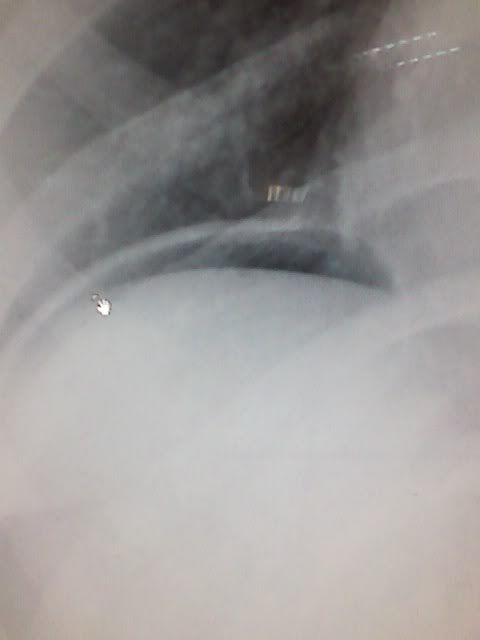
I suspected a PGU (perforated gastric ulcer), while the MO thought of maybe something else. Surgical referral was made, with chest + abdominal radiographs done. Chest X-Ray initially showed air under the diaphragm, while abdominal X-Ray showed suspicion of dilated large + small bowel. However, a repeated chest X-Ray with air syringed into the stomach via NG tube showed that the "air" became smaller, and thus surgical team concluded that it was unlikely. By this time, UFEME results returned, revealing blood, WBC's and nitrite. A provisional of UTI was made by the surgical team with referral to the medical team, but I thought still of PGU, my MO of perforated small bowel, another of PGU like me, while boss thought of the possibility of ectopic, though unlikely especially with negative UPT. She tried to get a radiological opinion of the initial chest radiograph, but no radiologists could be contacted at the time. And thus even though her clinical state has improved, her definitive "diagnosis" was still uncertain. Heck, even amylase was raised (almost to 250).
Question: Is it possible to have a "false positive" air under diaphragm? Googling failed me. Here's the initial radiograph:
3) Hm, another young male with no known history of medical illnesses came with tingling of fingertips and toes. Appeared hyperventilating. Tingling disappeared with reassurance to breath normally, just waiting for normal blood electrolytes investigation for discharge. Are today's men becoming baby boys? Hehe...This was the 2nd case of male hyperventilating from "anxiousness" in the week.
4) Elderly male came in with constitutional symptoms, and history suggestive of dysphagia, constipation & melena. But he was generally stable and actually quite cheerful. Examination was unremarkable, with no melena as well. Chest radiograph showed local consolidation in the middle zone of the right lung, and reporting was requested for expert opinion. How was the best way to manage the follow-up: specialist clinic/KK? The MO in charge opted for neither, telling him to come again to the green zone (!) in a week. This was to make it easier (and certainly faster than going to the KK) to present the radiological report from the radiologist and correlate it clinically.
Wednesday, May 27, 2009
ED Hell Continues
Today I was again at red, where I feel that I'm more and more like a Jonah (is that how we spell it?) in that zone.
And the system of waiting for investigations before departments accept patients made things pretty stressful. There was one patient who had an obvious case of ruptured/impeding rupture of an ectopic pregnancy: generalized lower abdominal pain referred to the shoulder, difficulty in taking deep breaths, LMP with positive UPT and PV spotting with pallor. GP trans-abdominal scan showed no POC in-utero. But we had to wait for blood results which only returned 2 hours later: Hb was dropping down to 7. Then did the O&G MO see her, and found an adnexal mass with free peritoneal fluid. Of course she was sent to OT stat. I felt tempted to perform a cervical excitation test to just get her referred already.
How about over-triaging for political reasons? There was an elderly lady with 3 days of acute gastroenteritis, and clinically only mild dehydration and hyperventilation without Kussmaul breathing. Past history suggestive of BPPV without seeking medication, and HPT/DM/LVH on meds. The dagger? She was tolerating orally! She was here in red because she's the mom of the previous director. Only managed with maintenance fluids and nourishing fluids brought in by the ex-director (contradictory, no?).
Of course boss had to attend to her (being in red) with me accidentally stuck there as I attended her before the MO; better manpower could've been sent to the patient with CKD, decompensating CCF, DIVC with underlying septic shock. He was there from morning to evening, as departments argued where to send him, until ICU decided to accept him, but pending on waiting for a patient to be TO'd.
Had an interesting case of hypokalemic paralysis, but couldn't clerk her as I was busy seeing other patients and she was sent to the wards when I was a bit free.
Having to pick up the slack for the MIA doctor, Nu'aim and I only returned home at 6 pm, one hour late. Totally screwed my plan to go to the gym tonight, as I was completely drained, forced to "lead"* the management of a patient with hypoglycemic coma with almost impossible vascular access (got an ankle access on our 7th try), as there were no doctors around when he came around 5 pm. Soon after, the yellow zone doctors had to cover the red, while one of the green doctors shifted to yellow when they knew of the MIA doctor.
I felt some pity going back, but hey, you shouldn't overwork if you're on office hours duty instead of shifts.
But stress leads to good timely humor. Quote of the day of an ENT MA to an uncooperative patient a week back:
"Aiyoo, uncle, tolong duduk diam...Sudah pukul 5 lah! Saya mau balik..." (Uncle, please sit still, it's 5 already! I wanna go home!)
Or at least something like that. But seeing others post pics make me jealous, as I don't have a camera, and can't take pics anyway as there's no time to slack off from "work"; at least any sort of humor relieves the stress.
*Not a good thing, especially when other doctors/patients/relatives think that you're a doctor. There can't be responsibility without power, just as it goes the other way around.
Thursday, May 21, 2009
When Worrying Too Much is a Problem, Literally.
Interesting cases today (as thinking exercises for to-be final year students):
1. Middle-aged woman presented with clear mucus coughing + SOB, LOA, LOW for 2 weeks 3 days, associated with pleuritic chest pain, night sweats and shivers. On observation, her eyes are opened extremely wide, face is pale but pink conjunctiva, very anxious, a bit tachypneic (20-22 breaths per minute). But the best part is that despite dyspnea, her SpO2 was 100% under room air. While clerking further she complained of cramping sensation of the fingers. This is her second visit to ED. Spot diagnosis?
2. Middle-aged man with no known history of medical illnesses presented with sudden severe headache, giddiness, nausea and vomiting since 30 minutes. No SOB or chest pain. Lungs clear. ECG and capillary sugar were normal. Similar episode a few months ago, resolved on its own. Differential?
3. Ever seen the pain of a patient with classical renal colic? Writhing about moaning in pain, hand at loin. What should you do first after allergy screen?
4. Elderly woman with a history of hypertension for about 10 years presented with fever and cough for 2 days, associated with shortness of breath, pleuritic chest pain and disorientation. Examination revealed edema up to both knees, coarse crepitations in middle to lower zones bilaterally, with displaced apex beat. Provisional?
5. 2 month old baby boy presented with history of 1 week on and off fever and cough, rapid breathing, difficulty in feeding. Examination revealed tachypnea, subcostal retractions with rhonchi and crepitations. Impression?
6. 7 year old boy complained of left testicular pain. We didn't manage to see the patient, but what is the no 1 diagnosis to be assumed until proven otherwise?
7. Classical description of a dengue macular rash?
1. Hyperventilation with underlying pneumonia, probably CAP. The patient was so anxious about her pneumonia that she developed respiratory alkalosis during clerking, instantly relieved by breathing into a bag. Radiograph showed perihilar and lower zone haziness. Sputum for AFB negative.
2. Rule out cardiac causes. Always check the vital signs. This patient had hypertensive emergency (encephalopathy) revealed by taking the BP (I purposely did not reveal it the above even though it was obvious when checking the BP). Lowered the BP with oral nifedipine down to 140 systolic and he was completely back to normal.
3. Just give her analgesia and she will "shut up" (a good thing). From 10 to 3 pain score instantly.
4. CAP, to rule out decompensated CCF.
5. Bronchiolitis probably complicated with secondary pneumonia.
6. Torsion torsion torsion. Remember the location of both testes relative to each other (which one is higher) and correlate with the presentation of patients. It's clinical embryology? What if the left is higher than the right?
7. White islands in a red sea. Don't forget how to perform a Hess's test and it's interpretation.
Subscribe to:
Posts (Atom)
